
Discussions
Corporate Tax for Free Zones in Dubai – Maximize Benefits & Ensure Compliance
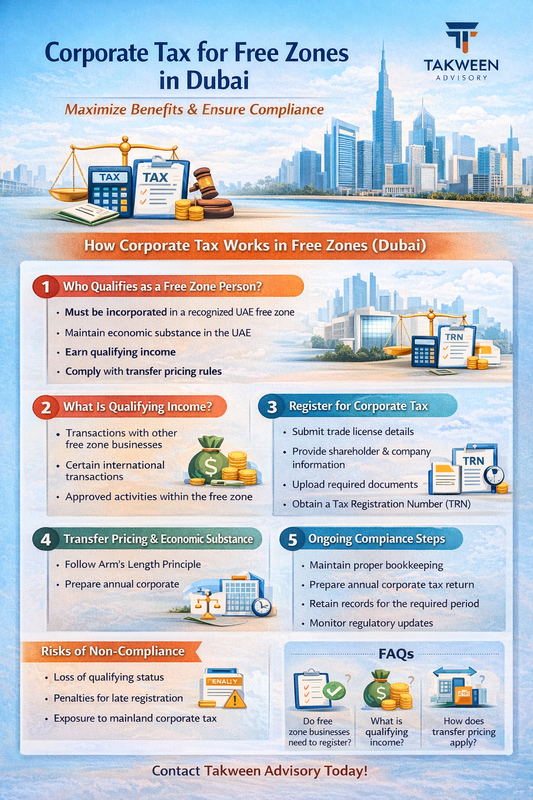
Dubai’s free zones have long been a hub for entrepreneurs and international businesses, offering flexibility, full ownership, and streamlined regulations. However, with the introduction of Corporate Tax for Free Zones in Dubai, companies must now ensure full compliance while maintaining their preferential benefits.
Although free zone companies can still enjoy favorable treatment, this is conditional. Proper understanding, planning, and compliance are essential to avoid risks and preserve your tax advantages. At Takween Advisory, we guide businesses every step of the way, from registration to strategic compliance planning.
How Corporate Tax Works in Free Zones (Dubai)
Corporate tax now applies across the UAE, including free zones. The treatment for free zone businesses depends on whether they qualify as a Qualifying Free Zone Person (QFZP).
Here’s how it works:
- Free zone companies must register for corporate tax.
- They must maintain proper accounting records.
- They must file annual corporate tax returns.
- They must comply with transfer pricing regulations.
If a company meets all qualifying conditions, it can maintain its preferential treatment on qualifying income. If not, the business may be subject to standard corporate tax rules.
Takween Advisory helps businesses assess their qualifying status and ensures smooth compliance with all requirements.
Who Qualifies as a Free Zone Person?

To retain favorable tax treatment, a free zone company must:
- Be incorporated in a recognized UAE free zone
- Maintain adequate economic substance in the UAE
- Earn qualifying income
- Comply with transfer pricing regulations
- Meet all regulatory and reporting obligations
Failure to meet these conditions may affect your tax position. Takween Advisory evaluates your company structure to identify and address any compliance gaps.
What Is Qualifying Income?
Qualifying income typically includes:
- Transactions with other free zone businesses
- Certain international transactions
- Approved activities within the free zone
Income from mainland UAE customers may affect your qualifying status depending on the transaction structure. Proper income classification is critical to maintain tax advantages.
Our team at Takween Advisory reviews revenue streams carefully to ensure accurate reporting and compliance with the law.
Corporate Tax Registration for Free Zone Companies

All free zone entities must register with the Federal Tax Authority (FTA), even if they qualify for preferential treatment.
The registration process includes:
- Submitting trade license information
- Providing shareholder and company details
- Uploading required documentation
- Receiving a Tax Registration Number (TRN)
Mistakes or delays in registration can lead to penalties. Takween Advisory manages the entire registration process, ensuring your business is fully compliant and timely registered.
Transfer Pricing Compliance
Transfer pricing is a critical part of corporate tax for free zone in Dubai.
If your company conducts transactions with related parties, including:
- Parent companies
- Subsidiaries
- Sister companies
…these transactions must comply with the Arm’s Length Principle, meaning they must reflect fair market value.
Free zone businesses may need to prepare:
- Transfer pricing documentation
- Supporting analysis
- Disclosure forms
Takween Advisory provides full transfer pricing advisory services to ensure all related-party transactions comply with UAE regulations.
Economic Substance Requirements
Free zone companies must demonstrate real business activity in the UAE to maintain qualifying status. This includes:
- Maintaining physical office space
- Employing staff where necessary
- Conducting core income-generating activities locally
Businesses that fail to meet economic substance requirements may lose their favorable tax treatment. Takween Advisory assesses your operational structure to ensure compliance with economic substance rules.
Ongoing Compliance Obligations
Corporate tax compliance is continuous, not a one-time task. Free zone businesses must:
- Maintain accurate bookkeeping
- Prepare financial statements following IFRS standards
- File annual corporate tax returns
- Retain records for the required period
- Monitor regulatory updates
Proactive compliance helps businesses avoid penalties and protect their reputation. Takween Advisory provides ongoing monitoring and guidance to ensure your free zone company remains fully compliant.
Common Risks for Free Zone Companies
Many businesses assume their free zone status automatically shields them from corporate tax obligations. This misconception can result in:
- Misclassification of income
- Ignoring transfer pricing requirements
- Failure to register on time
- Inadequate documentation
- Loss of qualifying status
Partnering with experienced advisors like Takween Advisory mitigates these risks and ensures a smooth, compliant transition.
How Takween Advisory Supports Free Zone Businesses

Navigating corporate tax for free zone in Dubai requires specialized knowledge. Takween Advisory offers:
- Corporate tax registration assistance
- Qualifying Free Zone Person assessment
- Income classification review
- Transfer pricing advisory
- Compliance monitoring
- Strategic tax planning
- Ongoing regulatory updates
We help free zone businesses maintain compliance while protecting their competitive advantages.
Strategic Tax Planning for Free Zone Companies
Proper planning ensures that your free zone business preserves its tax benefits. Key steps include:
- Reviewing revenue streams and contracts
- Structuring related-party transactions correctly
- Ensuring documentation is audit-ready
- Aligning operations with qualifying activity requirements
Takween Advisory develops tailored strategies to protect your business’s long-term growth and compliance.
FAQs – Corporate Tax for Free Zones in Dubai
1. Do free zone companies need to register for corporate tax?
Yes. All free zone companies must register with the FTA, even if they qualify for favorable treatment.
2. Are free zone businesses automatically exempt?
No. They must meet specific qualifying conditions to retain preferential treatment.
3. What happens if a free zone company loses its qualifying status?
The company may become subject to standard corporate tax rules.
4. Does transfer pricing apply to free zone companies?
Yes. Transactions with related parties must comply with the Arm’s Length Principle.
5. How can Takween Advisory help free zone businesses?
We provide full support, including registration, qualifying status assessment, compliance monitoring, and transfer pricing advisory.
Conclusion
Corporate Tax for Free Zones in Dubai introduces new compliance requirements while still offering benefits for qualifying companies. Proper planning, registration, income classification, and documentation are essential to preserve your tax advantages.
Free zone businesses must take proactive measures to protect their qualifying status and remain compliant.
Takween Advisory provides expert advisory and compliance support tailored for free zone businesses. From registration to strategic tax planning and ongoing monitoring, we ensure your company remains compliant, secure, and prepared for future regulatory changes.
Contact Takween Advisory today to maximize your benefits and ensure compliance with corporate tax for free zone in dubai.